

The "God of Investing"
If you’re involved in stocks or investing, you’re sure to know Warren Buffett.

Influenced by Benjamin Graham, he invests by purchasing stocks that are undervalued despite their intrinsic value.In 2008, he even ranked number one on the world’s richest list. His net worth was $62 billion. I can’t even imagine that ( ̄▽ ̄;)
The company where this “god” serves as the largest shareholder, chairman, and CEO is Berkshire Hathaway.

Oh, and this person is beautiful, isn’t he? Who’s Anne Hathaway, anyway? (; ・`д・´)
VYM and Berkshire’s Performance
Vanguard’s VYM is a U.S. high-dividend stock ETF. It has an annual dividend yield of 3.2% (as of February 2), and its holdings consist entirely of major U.S. companies like Johnson & Johnson, Pfizer, and ExxonMobil, which gives it a sense of stability—that’s why I like it and continue to buy it.However, something’s been on my mind lately: I want to keep receiving stable dividends while also generating capital gains
.
I’d like to earn a steady stream of small dividends while having the capital gains effectively “prepay” several years’ worth of dividend income all at once. That’s the feeling I’m getting. Focusing solely on capital gains is exhausting, and I’m afraid of failing.But to truly benefit from the power of compound interest with stable dividend income, you need to accumulate a significant amount.
That’s why I’m interested in Berkshire Hathaway. Berkshire doesn’t pay dividends. Instead, it spares no effort to drive up its stock price. A Bloomberg article from July 18, 2018, mentioned this as well.
Shareholders of U.S.-based Berkshire Hathaway may soon reap the benefits of the $109 billion (approximately 12 trillion yen) in cash on hand that has been troubling Warren Buffett.
On the 17th, Berkshire’s board of directors announced that it would remove the cap on share buybacks. This gives Mr. Buffett, the company’s chairman and CEO, greater discretion to return profits to shareholders rather than seeking out further acquisition targets.The company revealed that if Buffett and Vice Chairman Charlie Munger both determine that the stock price is “conservatively speaking, below Berkshire’s intrinsic value,” they will be able to conduct share buybacks at any time. (Quoted from a Bloomberg article)
By raising the stock price, they will benefit shareholders.
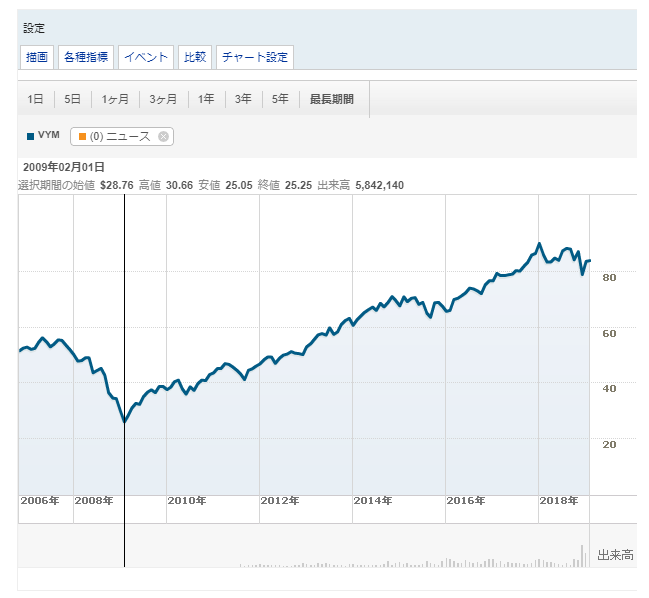
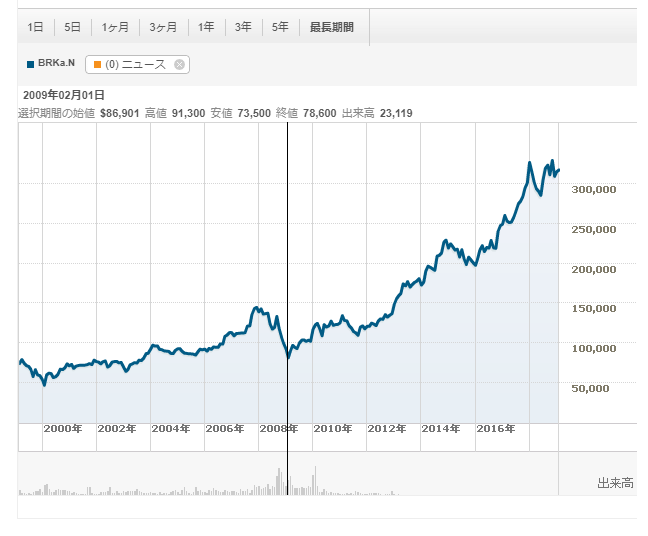
Now, here is a comparison of the stock price trends for VYM and Berkshire from 2010 to 2018. Since we are analyzing the longest period available on Reuters, differences may exist due to market crashes and surges.Calculations are based on closing prices from November 1, 2006, to February 1, 2019.
First, VYM

(Source: Reuters website)
The closing price on November 1, 2006, was $50.68, and the closing price on February 1, 2019, was $83.02—a gain of $32.34. This represents a 63.8% increase
.
Next is Berkshire Hathaway

The closing price on November 1, 2006, was $107.10, and the closing price on February 1, 2019, was $313.875, resulting in a gain of $206.775.That’s an increase of approximately 193%.
Based on these figures
alone, Berkshire Hathaway appears to have outperformed in terms of rate of return.
Also worth noting is the stock price on February 1, 2009. This was when both stocks hit their lowest point following the Lehman Shock.
VYM hit a low of $25.05, which was $25.63 lower than its price on November 1, 2006—a decline of approximately 50%.
In contrast, Berkshire Hathaway’s low of $73.50 was $33.60 lower than its price on November 1, 2006, representing a decline of only about 32%.
I had considered VYM to be an excellent defensive stock, but I was surprised to find that, unexpectedly, Berkshire Hathaway experienced a smaller percentage decline after the Lehman Shock. However, VYM pays dividends, which Berkshire does not. Yet, dividends come with the following problem…
Dividends are subject to taxation
That’s right—taxes
! As you know, U.S. stocks are subject to a 10% local tax and a 20.315% tax in Japan. While part of this is refunded through the foreign tax credit, I’ll skip the details here because it’s complicated (and a hassle…). lol Below
are the dividend amounts from 2006 to 2018.
2006: 0.175
2007: 1.357
2008: 1.443
2009: 0.888
2010: 1.091
2011: 1.327
2012: 1.593
2013: 1.749
2014: 1.908
2015: 2.149
2016: 2.206
2017: 2.401
2018: 2.649
Total: 20.936
Assuming we completely ignore taxes, you would receive $20.936 by 2018.Since VYM has gained $32.34 from November 2006 to the present, adding dividends to this brings the total to $53.276, representing an appreciation rate of approximately 105%. Even without deducting taxes, it still didn’t match the rate of appreciation seen in Berkshire Hathaway.
Is Berkshire a better buy than VYM?
Based on the results above, I personally believe that Berkshire Hathaway is a good buy, both as a defensive investment and in terms of capital appreciation. However, VYM offers significant peace of mind in that it allows for diversified investment in large, blue-chip companies, even if dividends are subject to taxation.I thought that buying ETFs like VYM for
risk diversification while also investing in Berkshire Hathaway to target capital gains might be a strategy to help grow my assets, even if only slightly.


コメントを残す