

About AT&T
Are you familiar with AT&T, the major U.S. telecommunications company? It is, in fact, a venerable, long-established company whose roots trace back to the Bell Telephone Company, founded by none other than Graham Bell.While its core business is telecommunications, in 2018 it acquired the former Time Warner (now WarnerMedia), one of the “Big Five” media conglomerates, and now also operates in areas such as television program production and distribution, film production and distribution, and publishing.Speaking of
WarnerMedia, it distributes various famous movies; off the top of my head, I can think of the Harry Potter series and the Ocean’s 11 series.It also owns CNN, a U.S. news channel that’s frequently seen on Japanese TV. It’s like Japan’s NTT Docomo, but on a completely different scale (ノ ̄□ ̄)ノ Ooooh!
Stocks with Consecutive Dividend Increases
Not only is it such a massive company, but it’s also a “Dividend Aristocrat” that has raised its dividends consecutively. The streak spans a whopping 35 years!
Unfortunately, there’s no company in Japan that has maintained a dividend increase for that long. The stock with the longest consecutive dividend increase streak in Japan is Kao, at 29 years (which is impressive enough, though).Among telecommunications companies, KDDI has a record of 17 years (which I think is impressive too, haha
). Now, regarding AT&T’s most recent dividend increase: on December 14 of last year, they announced a $0.01 per share increase.$0.01… You’d normally think that’s a bit underwhelming (-_-;), right? (laughs) Still, the fact that they continue to steadily increase their dividends shows their commitment to paying dividends to shareholders and their stance that they won’t cut dividends lightly.
When investing primarily for income, the biggest worry is a dividend cut. When I first started investing, I focused on Japanese companies with high dividend yields. What surprised me was how readily companies would suddenly cut dividends or scale back shareholder benefits. They’d introduce a new shareholder benefit, only to scrap it a few years later…I often found myself thinking, “I’ve been had!” in those situations, so I learned the risks of investing based solely on yield. It’s important to invest while considering whether
a company can continue paying dividends. It may be difficult to develop the expertise to make that judgment with complete certainty, but I believe companies with a history of consecutive dividend increases are a source of reassurance.
Dividend Yield
As for AT&T’s dividend yield, it stands at 6.64% as of January 30.
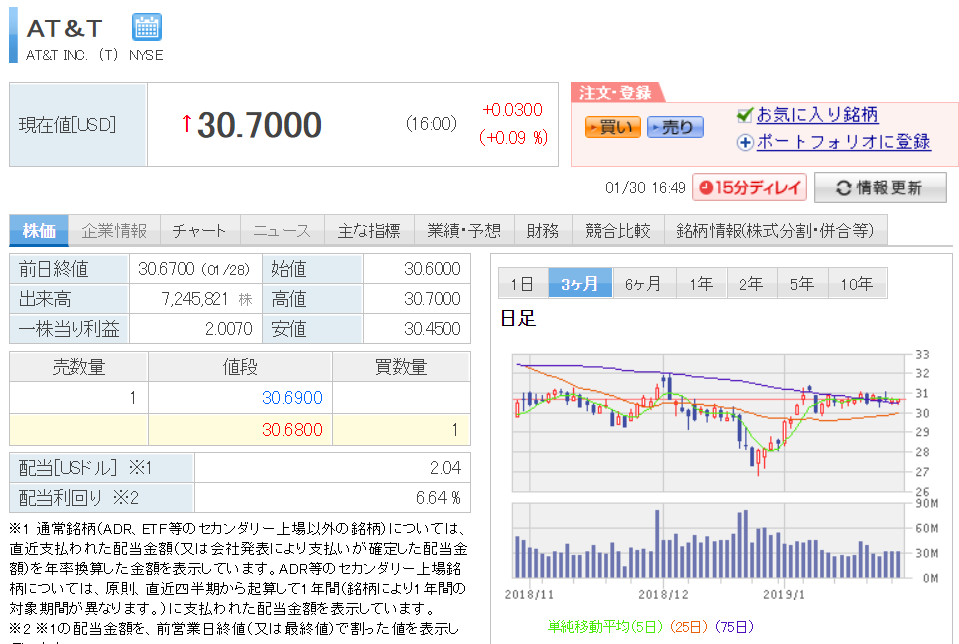
(Source: Rakuten Securities)
They pay $2.04 on a share price of $30.70. On December 24 of last year, the price was $27.36, so the yield was
7.
45%.It would have been great to buy at that time, but in situations like that, you end up hesitating because you think the price might still go down, lol ( ̄Д ̄;)w I ended up buying it for $29.
But why does a stock from a company that seems so stable have such a high yield? Personally, I think the next point to consider is the dividend payout ratio.
Dividend Payout Ratio
The dividend payout ratio for 2017 was 93.78%, meaning a significant portion of profits was allocated to dividends. Furthermore, in 2015, the ratio reached 208.89%, meaning the company paid out more than double its profits in dividends that year. I can’t help but feel they’re paying out a bit too much in dividends relative to their profits.
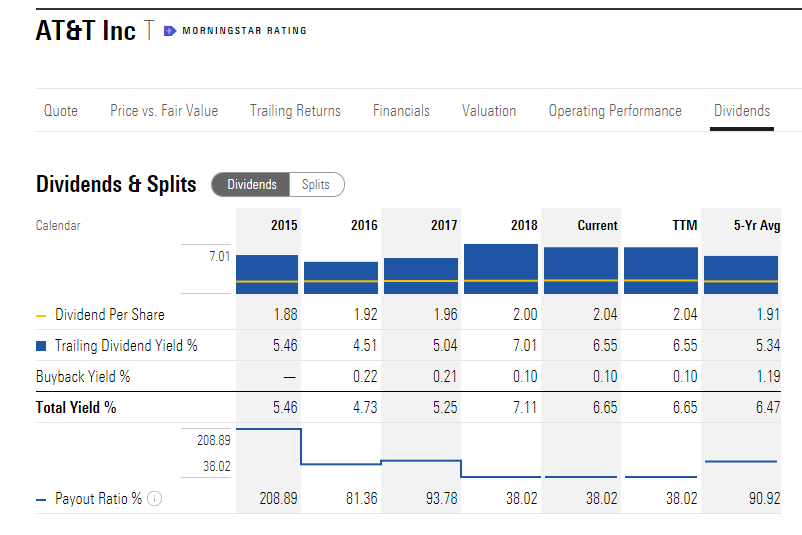
(Source: Morningstar website)
Since the earnings announcement for the fourth quarter of 2018 is scheduled for tonight, I’m curious to see how AT&T’s final 2018 results turned out.


コメントを残す