

Hello, tuna(@miyakojimalife_) (^^)
Investing has recently become a trend even among the younger generation.
Personally, I feel that around 2018, the number of people talking about investing on YouTube began to increase, and the videos posted by the “Two Deans” and Atsuhiko Nakata seem to be fueling an even bigger boom.
Even before that, there were individual investors who had been blogging about investing in U.S. and Japanese stocks, and many of them went on to publish books amid this boom.
“From Savings to Investing”The Financial Services Agency’s efforts to promote NISA have really paid off, haven’t they?
Amid this investment boom, I’d like to share three pitfalls that I—having drifted through the markets for about 14 years ( ꒪Д꒪)—feel beginner investors are prone to falling into.
Since this is just the perspective of a casual market observer—not an expert—I’d be happy if you could take it as just one opinion♪
Don’t blindly trust the stocks recommended by analysts and influencers.
I hardly ever watch YouTube videos about investing, financial planning, or tax savings.
The reason is that I’ve been reading self-help books since middle school, and I’ve learned a great deal about investing from books I’ve read since college, so I have a solid foundation of knowledge (I believe knowledge only becomes a true strength when put into practice).
As an exception, when it comes to blogs and YouTube channels run by people I’m connected with on social media, I view them out of interest in and support for them.
If you have some knowledge, you can make your own decisions, but when you’re just starting out and lack both knowledge and experience, you’ll naturally want to listen to the advice of those with experience.
And use this as a basis for your final decision
That in itself isn’t wrong, and I was like that myself.
One thing to keep in mind at this point is“Don’t Be Blindly Believing”that is
Analysts are professionals in their field, providing information on investments and financial analysis.
However, if you track their recommended stocks and stock prices for about a week to a month, you’ll likely realize that they’re almost never right.
In the stock market, where conditions change from moment to moment, even if you can make a general prediction, the trend can shift instantly.
Unless you buy and sell at the same time as they do and take profits or cut losses, you won’t be able to achieve good results with these recommended stocks.
In the long run, we may be able to maintain our direction, but what constitutes “the long run” varies from person to person.
The reason not to blindly trust influencers’ stock recommendations is the same as stated above.
Furthermore, since many people who are active as influencers tend to generate revenue through blogs, YouTube, books, and advertising rather than through investing, their experiences may not be particularly helpful as a reference for investing.
The point of following influencers is not as an investment, but rather,How to Create a Business StyleIt should be
I realized this after listening to the experiences of people I’ve actually met.
“What is the basis for their recommendation?” I believe that is the key factor in making a judgment and helps you develop a discerning eye.
Don’t make a large purchase right off the bat
Occasional articles in magazines and books about people who used their retirement savings to buy stocks and failed
I used to wonder, “Does that kind of thing really happen?” but then I heard from a friend that her father-in-law had actually made that mistake.
It seems my father-in-law was, after all, a beginner at investing; apparently, he tried to make a big investment using his retirement savings.
While it’s a good thing to focus on asset management, suddenly investing large sums of money in a field you know nothing about does indeed increase the risk.
You often see this in investment books and magazines
“Spread out both time and money”I feel that this is the standard approach and an effective method for both beginners and experienced travelers.
It’s often described using technical terms like “dollar-cost averaging” and “asset allocation,” but to put it very simply, it just means you should diversify your investments.
The Financial Services Agency also introduces this point on its website as a basic principle of investing.
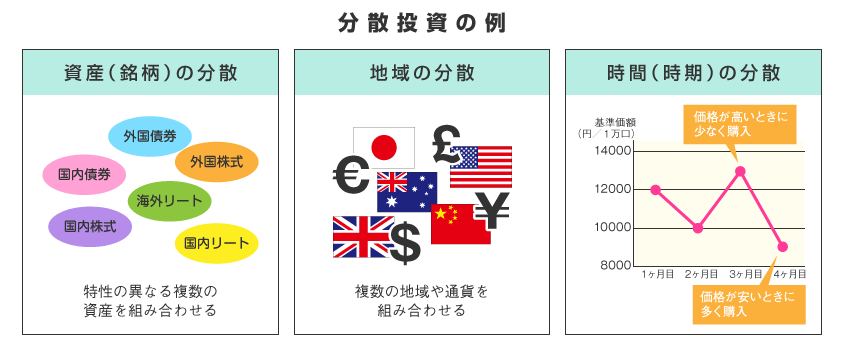
“Quoted from the Financial Services Agency’s website”
I doubt many people would think, “Let’s start investing!” and immediately open the Financial Services Agency’s website, but I recommend checking it out once you’ve gotten a little more comfortable with social media and YouTube.
Start with a small amount—an amount you can afford to lose—and get used to how trading works.
Next, I think it’s necessary to gradually increase the amount of money you invest in stocks and determine how much in unrealized losses or negative returns you can tolerate.
Even experienced investors often struggle to decide when to cut losses on unrealized losses, so I think beginners almost always end up holding onto these losing positions indefinitely (or selling them and giving up on stock investing altogether).
The amount I can afford at this time isRisk ToleranceThat’s it.
This varies depending on an individual’s financial situation, family structure, life plans, and mindset or attitude toward investing.
If you invest an amount that exceeds your annual income—or is equivalent to several years’ worth of income—your monthly take-home pay can fluctuate—either up or down—in the blink of an eye, so it’s essential to assess your risk tolerance beforehand.
While diversifying your portfolio when you have limited assets means you won’t see significant growth, I think it’s a good approach for getting used to stock investing in a variety of ways.
There are no guarantees when it comes to financial products.
Currently, both Japanese and U.S. stocks continue to trend higher.
Stock prices plummeted in 2008 during the Lehman Shock, but subsequently, Abenomics in Japan and the Trump rally in the U.S. drove stock prices higher.
Given that bull and bear markets had been alternating roughly every 10 years, it was predicted that the market would enter a bear market following the sharp declines caused by the 2018 Christmas Shock and the 2020 COVID-19 Shock.
However, stock prices remain high even now.
Amid this prolonged bull market, those who have only ever experienced this kind of marketIf you hold onto stocks, their value will definitely go up.I feel like more and more people are thinking that way.
It is true that the S&P 500, a well-known U.S. index, boasts an annual growth rate of 7%.
However, this is an average return, and there have been periods when returns were negative.
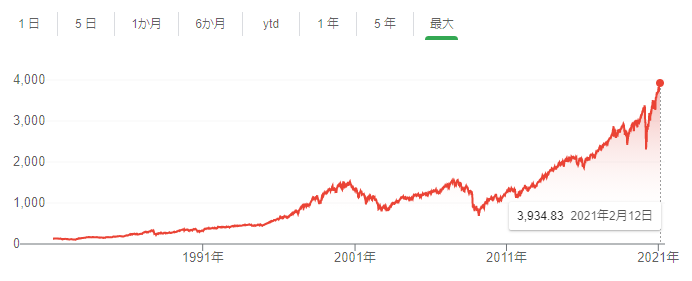
“Quoted from Google Finance”
If you have diversified your assets as explained in “② Don’t Invest a Large Sum All at Once” and understand your risk tolerance, you may be able to weather a bear market lasting several years to several decades.
Since the money you expect to need in the future may not necessarily be in the form of unrealized gains when you actually need it, it is commonly referred to as“Invest only with surplus funds.”That hits the mark.
Since it’s difficult to make a significant return on a small amount of surplus funds, I think it’s important to increase the amount of surplus funds you have.
- Think for yourself about what makes it worth recommending.
- Diversify both your time and your assets
- Invest with surplus funds
Investments are a never-ending endeavorAsset AllocationI think so
I hope this article is helpful for those who are just starting out with stock investing♪
Thank you for reading to the end*ᴗ ᴗ)⁾⁾


コメントを残す